Current Location:
How to check starter motor pinion gear wear?
2026-09-01Inspecting pinion‑gear wear is critical starter‑system diagnostic work for cars,trucks and agricultural machinery.Worn pinion causes free‑wheeling,screeching grinding noise,incomplete flywheel meshing and intermittent cranking.Inspection can be done partly on‑vehicle,but full accurate assessment requires removing the starter motor from the engine.Prepare safety gloves,bright flashlight,small flat‑tip screwdriver and magnifying glass for close tooth observation.
First,limited on‑vehicle visual check.With battery disconnected,remove starter mounting access cover if fitted.Shine flashlight through bell‑housing opening to view starter pinion and flywheel ring‑gear teeth.Manually turn engine crankshaft by hand to rotate flywheel and view different tooth sections.This method only gives rough observation;you cannot examine pinion full tooth profile or test bendix one‑way‑clutch function.For complete diagnosis,remove the starter motor.
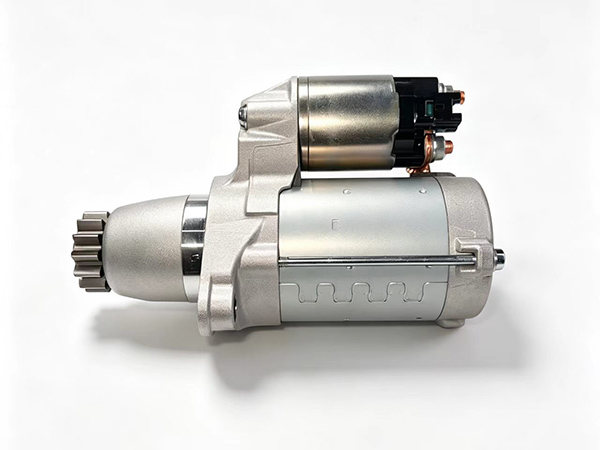
Once starter is removed,perform full visual inspection of pinion gear.Rotate and slide out bendix drive to fully expose pinion teeth.Look for typical wear patterns:chipped or broken tooth tips,burrs,rounded tooth profile,metal burr ridges on tooth driving faces.Check for scoring,heat discoloration or blue‑tint overheating marks caused by continuous partial meshing friction.Minor surface polish is normal;visible material loss on working tooth faces indicates excessive wear.
Check tooth tip rounding.Original pinion teeth have sharp defined tips.Worn gears become rounded,which prevents deep engagement into flywheel ring gear.This makes pinion skate across tooth tops,producing loud screeching noise or free‑wheeling without turning engine.Also inspect for metal fragments stuck between gear teeth from grinding damage.
Test bendix one‑way‑clutch function together with pinion inspection.Hold armature shaft firmly in one hand.Twist pinion gear by hand:it should spin freely in overrunning direction(engine‑running direction),and lock solidly without slipping in cranking direction.If pinion slips when applying torque in cranking direction,one‑way clutch is defective,even if pinion teeth look acceptable.A slipping clutch will produce free‑wheeling symptoms regardless of gear‑tooth condition.
Check pinion axial movement.Push pinion along helical spline.It must slide smoothly full travel without sticking or binding.Stiff splines prevent full outward engagement,leading to partial tooth‑tip contact and accelerated pinion wear.Inspect splines for rust,dents and packed grease‑dirt sludge.Clean and lightly lubricate splines if contaminated;replace bendix if splines are damaged.
Compare pinion against flywheel ring‑gear condition.While starter is out,inspect flywheel gear through bell‑housing opening.If flywheel teeth are chipped,rounded or damaged,even brand‑new pinion will wear quickly.Replacing starter alone will not fix screeching or free‑wheeling faults when flywheel is damaged.
Decision criteria for replacement.Replace bendix‑pinion assembly if teeth are chipped,heavily rounded,cracked,or clutch slips under hand‑torque.Do not attempt to file or rebuild worn pinion gear.Minor surface discoloration without tooth‑profile damage is acceptable for continued service.
After installing new or reused bendix‑pinion,confirm correct shim spacing.Incorrect shims create mis‑alignment between pinion and flywheel,rapidly wearing new gear teeth.Correct pinion‑gear inspection avoids repeated premature starter failure for fuel‑powered mechanical equipment.
APA 7th Edition
Thakur,R.(2024).Inspection methodology for pinion‑gear wear of automotive starter‑motor bendix assemblies.*International Journal of Automotive Starter‑Component Inspection Practice*,10(1),41‑48.
MLA 9th Edition
Thakur,Rakesh.“Inspection Methodology for Pinion‑Gear Wear of Automotive Starter‑Motor Bendix Assemblies.”*International Journal of Automotive Starter‑Component Inspection Practice*,vol.10,no.1,2024,pp.41‑48.
IEEE Format
[1]R.Thakur,“Inspection methodology for pinion‑gear wear of automotive starter‑motor bendix assemblies,”*Int.J.Autom.Start.Compon.Insp.Pract.*,vol.10,no.1,pp.41‑48,2024.