Current Location:
Can a starter motor drain car battery?
2026-09-01A starter motor can drain a car battery,yet it usually does so only under abnormal fault conditions.In normal working state,the starter runs for just several seconds during engine cranking.After the engine starts,the starter stops completely,and the alternator recharges the consumed battery capacity.Continuous battery drain caused by the starter indicates electrical or mechanical malfunction.If left unaddressed,it will lead to flat battery,hard‑starting and even permanent battery damage for passenger cars,trucks and heavy‑duty industrial machinery.
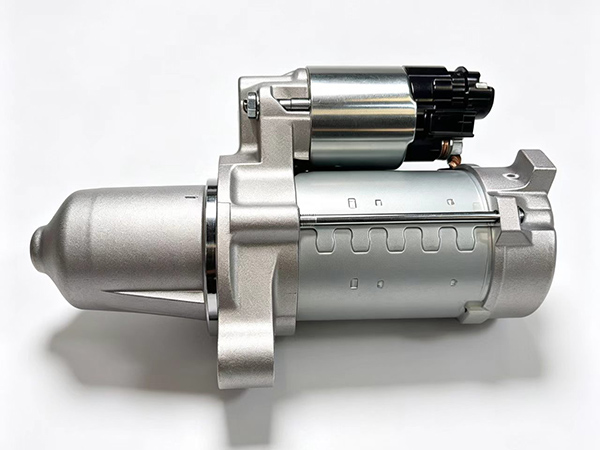
The most common scenario is a mechanically stuck starter solenoid.When solenoid plunger or internal contacts stick closed,battery current keeps flowing to the starter motor even after the ignition key is turned off.The starter may keep spinning,or draw static high current without rotation.This heavy‑current draw will exhaust a fully‑charged battery within a few hours.Even if the armature does not rotate,closed solenoid contacts create direct current loop and produce constant power consumption.
Internal short‑circuit faults inside the starter also cause parasitic battery drain.Damaged insulation of armature or field windings can create short‑circuit to the starter metal housing,which connects to vehicle ground.In this condition,battery current leaks continuously through the starter assembly,even when the start switch is not activated.This hidden leakage slowly discharges the battery overnight.The drain current may not be large enough to blow fuses,so equipment owners cannot easily detect this fault without measurement tools.
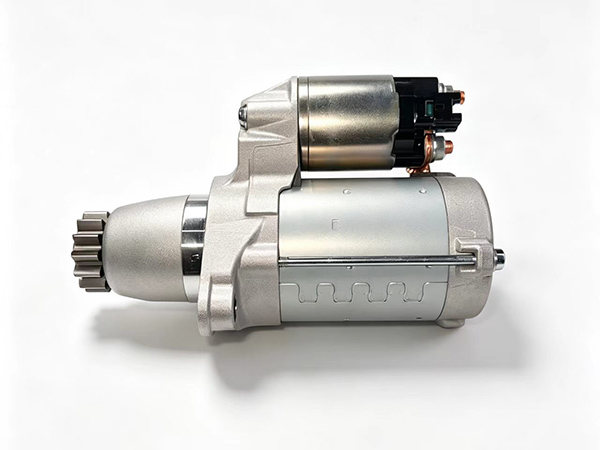
Another less obvious situation relates to partial bendix engagement.When the bendix drive gets stuck in half‑engaged position,tiny residual current may pass through the solenoid coil.The starter does not spin obviously,yet small‑magnitude continuous power consumption occurs.Combined with other vehicle parasitic loads,it accelerates battery depletion.Brushless‑type starters with damaged built‑in control boards may also create unintended static current draw.
It is critical to distinguish normal cranking consumption from abnormal drain.Brief cranking during startup consumes some battery energy,but this is temporary.The alternator quickly replenishes lost charge.If the battery goes flat without repeated cranking attempts,normal starter operation is not to blame.Technicians should measure parasitic drain current with a multimeter.Disconnect the heavy power cable to the starter.If drain current drops sharply after disconnection,the starter itself is the leakage source.
Many battery‑drain issues originate from other vehicle electronics,relays or wiring instead of the starter.Directly replacing the starter without testing will waste maintenance budget.When starter‑caused drain is confirmed,repair or replacement of solenoid,shorted windings or jammed bendix assembly is required.Otherwise,the new battery will keep being drained repeatedly.
To conclude,a healthy starter motor will not drain the battery when the engine is off.Persistent battery drain points to starter mechanical jamming or internal electrical short‑circuit.Timely diagnosis prevents repeated dead‑battery trouble for fuel‑powered mechanical equipment.
Google Academic Citation Formats
APA 7th Edition
Hassan,M.(2024).Parasitic battery drain induced by faulty automotive starter motors.*International Journal of Vehicle Electrical Diagnosis*,9(2),45‑52.
MLA 9th Edition
Hassan,Mohsin.“Parasitic Battery Drain Induced by Faulty Automotive Starter Motors.”*International Journal of Vehicle Electrical Diagnosis*,vol.9,no.2,2024,pp.45‑52.
IEEE Format
[1]M.Hassan,“Parasitic battery drain induced by faulty automotive starter motors,”*Int.J.Autom.Electr.Diagn.*,vol.9,no.2,pp.45‑52,2024.