Current Location:
How Does a Starter Motor Work? A Complete Guide
2026-09-13Of all the electric machines on a vehicle, the starter motor works harder for a shorter time than any other. For a few seconds it drags a cold, oil-heavy engine through its compression cycles, drawing hundreds of amps, and then it must drop out of the mechanical chain completely so the running engine cannot destroy it. Understanding how does a starter motor work is not academic: for engineers, purchasing professionals and workshop technicians, it is the difference between diagnosing a failed start in minutes and replacing parts at random.
This guide is a deep dive into the mechanism rather than a product overview. It follows the full electromechanical sequence from key turn to engine fire, explaining the physics behind each step — from electromagnetism and commutation to gearing and clutch action.
The Starter Motor in the Car Starting System
An internal-combustion engine cannot start itself from standstill: with no airflow, compression heat or ignition event at zero speed, it needs external torque to draw in a charge, compress it and reach a firing condition. That torque comes from the starter motor, part of the car starting system.
The starting system contains two separate electrical circuits. The control circuit carries a small current from the ignition switch or start button, typically through a relay, to the solenoid. The power circuit carries the large cranking current from the battery, through heavy cables and the solenoid's main contacts, to the motor and back to ground through the engine block. Most starting faults live at the boundary between the two: a switch that does not energize, a solenoid that does not hold, or a power path with too much resistance.
Anatomy of a Starter Motor
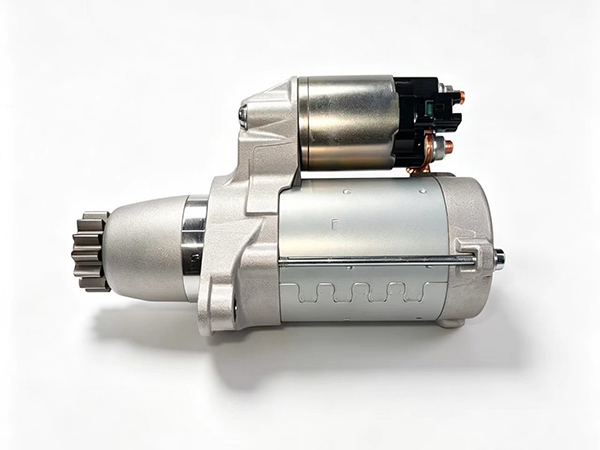
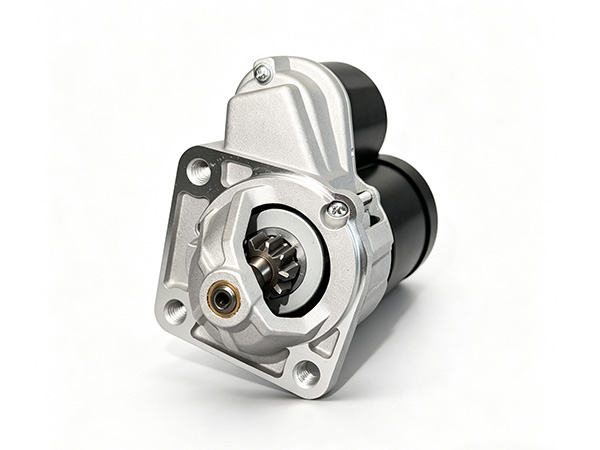
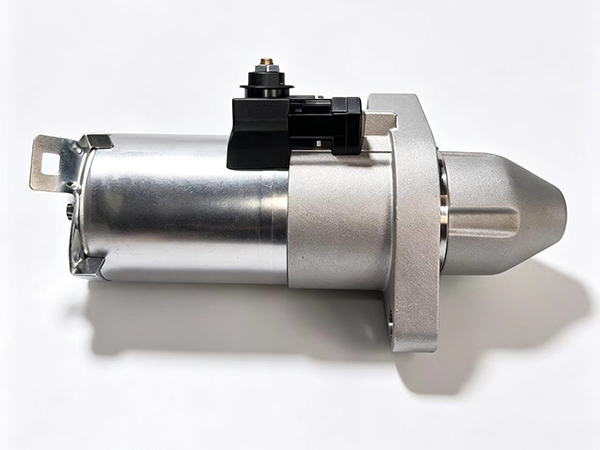
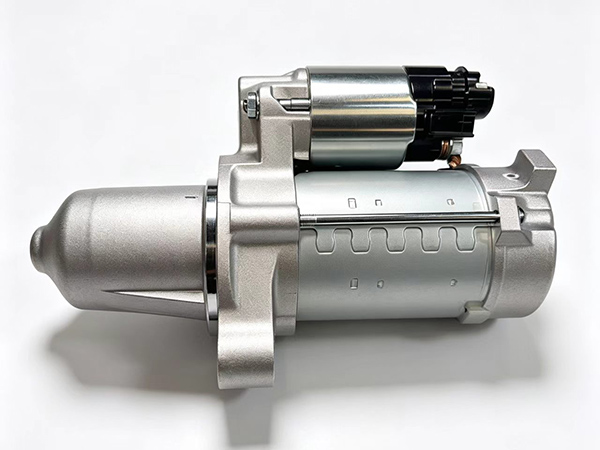
Housings and mounting patterns vary between engine families, but a modern pre-engaged starter contains the same core elements:
Armature — the rotating assembly of laminated iron and copper windings that produces rotation when current flows.
Commutator and brushes — a rotary switch on the armature shaft, contacted by stationary carbon brushes, that keeps current direction correct in each winding as the rotor turns.
Field windings or permanent magnets — the stationary source of magnetic flux inside the housing. Older and larger starters use series-connected field coils; compact modern designs often use permanent magnets with internal gear reduction.
Solenoid — a linear electromagnetic actuator that pushes the pinion into mesh and closes the heavy main contacts carrying cranking current.
Shift lever — the mechanical link translating the solenoid plunger's stroke into pinion movement.
Pinion — the small gear that meshes with the much larger ring gear on the flywheel.
One-way (overrunning) clutch — the torque coupler between armature and pinion, transmitting drive in one direction only. Inertia designs, where threads fling the pinion into mesh, are the classic Bendix drive.
The Cranking Sequence, Step by Step
The entire start event lasts only seconds, but it is a precisely ordered sequence of seven events — the starter motor working principle reduced to its mechanical core:
Step 1 — The control circuit closes. The driver turns the key to START or presses the start button. Small control current flows through the ignition switch, usually via a relay, to the solenoid's coil terminals.
Step 2 — The solenoid pulls in its plunger. Energized coils generate a magnetic field that draws the iron plunger into the solenoid body against spring pressure.
Step 3 — The pinion moves into mesh. The plunger, through the shift lever, pushes the drive toward the flywheel until the pinion teeth engage the ring gear. In a pre-engaged design the motor is still turning slowly, so the teeth slide into mesh with minimal clash.
Step 4 — The main contacts close. Near the end of the stroke a contact disc bridges the heavy studs inside the solenoid, connecting battery positive directly to the motor's field circuit.
Step 5 — The armature rotates under electromagnetic force. Full battery current — typically hundreds of amps — flows through the field and armature windings via the brushes and commutator; the current interacting with the magnetic field produces torque, and the armature spins.
Step 6 — The engine cranks. Torque flows through the one-way clutch and pinion to the ring gear, rotating the crankshaft through intake and compression strokes until the first cylinders fire.
Step 7 — The drive disengages. The engine now spins far faster than the starter ever did, so the one-way clutch overruns to stop the engine driving the armature; when the key is released, the solenoid de-energizes and its spring opens the contacts and withdraws the pinion.
The Physics: Why the Armature Rotates
The motion in step five is a direct application of electromagnetic induction. The armature carries conductors that sit inside the magnetic field produced by the field windings or permanent magnets, and a current-carrying conductor in a magnetic field feels a force proportional to current, length and field strength; wound at a distance from the rotor axis, those forces become torque and the rotor turns.
The torque curve is what makes a starter special. In a classic series-wound starter the field coils carry the same current as the armature, since they are connected in series. When the engine refuses to turn, current is at its maximum, the magnetic field is at its strongest, and the motor produces its greatest torque at the moment it is completely stalled — exactly when the engine needs it most. As speed rises, torque falls naturally. Permanent-magnet gear-reduction starters get the same result differently: a fixed strong field plus internal gearing multiplies torque in a smaller, lighter unit.
Commutation is the detail that makes a DC motor work. As the armature rotates, each winding moves from one magnetic pole to the other; if current direction never reversed, the forces on each conductor would flip halfway through every revolution and the rotor would stall. The commutator — a cylinder of copper segments on the armature shaft — rotates with the rotor while stationary carbon brushes press against it, swapping current connections at exactly the right moment so torque direction never reverses. Brush and commutator wear is therefore a normal life limit, not a design fault.
Finally, back electromotive force (back-EMF) explains most starter damage. A rotating conductor cutting magnetic flux generates its own voltage, opposing the supply. At the first instant of cranking the armature is stationary, there is no back-EMF, and current is limited only by winding resistance — hence the enormous starting surge. As the armature speeds up, back-EMF rises and current falls. If the armature cannot spin — a seized engine, a jammed pinion or a locked clutch — current stays at peak and the windings can melt in seconds, which is why starters are rated for intermittent duty only.
The Solenoid: Switch and Actuator in One Part
The solenoid is the starter's decision-maker, and understanding its solenoid function explains half of all starting faults. Its job is to use a small control current to switch a power circuit carrying hundreds of amps — no ignition switch could handle that load directly.
It contains two coils and a set of heavy contacts. The pull-in winding is connected in series with the motor; the hold-in winding goes to ground. When both are energized, their combined flux pulls the plunger in, moving the shift lever and pinion. Near the end of the stroke the contact disc closes the main studs and full battery voltage reaches the motor. At that instant the pull-in winding has the same voltage on both ends — it is effectively bypassed — while the hold-in winding keeps the plunger seated.
This two-winding design explains the classic symptom of a weak battery. If voltage collapses the moment the contacts close, the hold-in winding can no longer hold the plunger, the spring pulls it back, the contacts open, and the cycle repeats as rapid chattering clicks — the solenoid is not failing, the power supply cannot sustain the job.
The Drive: Meshing, Gear Ratio and the One-Way Clutch
The connection between starter and engine is a temporary gear mesh, and the way that mesh is made and broken is the heart of the starter motor mechanism. Two design families exist. The classic inertia Bendix drive mounts the pinion on helical threads: when the armature spins, the pinion is screwed outward until it slams into the ring gear. It is simple and cheap, but engagement is violent and it grinds badly if the engine is still rotating — which is why it has largely disappeared from modern vehicles.
Modern starters use the pre-engaged drive described above, meshing the pinion before heavy current flows. The pinion typically has a fraction of the ring gear's teeth — commonly a ratio of roughly ten or fifteen to one — converting high-speed, moderate-torque rotation into the low-speed, high-torque cranking the engine needs.
The one-way clutch is a safety device, not a luxury. Once combustion begins, the engine accelerates far beyond anything the starter produced. If the pinion stayed locked to the ring gear, the engine would drive the armature through the gear ratio at many thousands of revolutions per minute, far beyond the mechanical limits of its commutator and windings. The clutch's rollers or sprags sit in tapered ramps: in the drive direction they wedge and transmit torque; in overrun they release and let the pinion freewheel.
Common Failure Modes and What the Symptoms Mean
Because the sequence is so well ordered, symptoms map cleanly onto mechanisms. Before blaming the starter, check the battery and the cables, terminals and ground strap — many "starter failures" are high-resistance connections. The classic symptom set:
A single click and no cranking. The plunger moved but the main contacts did not close, or voltage collapsed before the motor could turn. Causes range from worn contact discs and dead cells to corroded cables.
Rapid chattering clicks. The hold-in winding cannot hold the plunger because supply voltage collapses whenever the contacts close. Check battery charge, terminals and cables first.
Free spinning, no cranking. The armature turns but delivers no torque: a worn-out overrunning clutch transmits nothing, a broken shift lever never meshes the pinion, or the pinion teeth are stripped. The fault is in the drive, not the motor.
Grinding or crunching. Gear teeth are clashing instead of meshing — a worn ring gear, engagement while the engine is spinning down, or a worn shift mechanism that engages the pinion too early or late.
Slow, labored cranking. Either the starter cannot deliver torque or the engine resists it: weak battery, high cable resistance, worn brushes or bushings, or engine-side drag such as very thick oil.
The starter stays engaged after start. A whining drive that will not drop out means welded solenoid contacts or a stuck plunger, spinning the pinion at destructive speed. Fix it immediately — it can destroy the commutator and ring gear.
Intermittent starts and burning smells. Worn brushes, a dirty commutator or loose connections cause unreliable contact, and every failed attempt adds heat. A burning varnish smell means winding insulation is being cooked by excessive current and prolonged cranking.
Finally, two reminders: cranking is duty-cycle work, so repeated long attempts point toward the engine or fuel system rather than the starter, and many failed starters are failed connections — measure voltage drop across every joint before condemning the unit.
Frequently Asked Questions
Why does the starter click once but the engine does not turn?
A single click means the plunger moved, so the control circuit is probably intact. The fault is in the power path: worn main contacts cannot carry current, or battery voltage collapses the moment the load is applied. Check battery voltage under load and the voltage drop across cables and solenoid studs before condemning the starter.
Why would a starter spin but not crank the engine?
The motor whirs but the engine never turns because the armature rotates without delivering torque. The usual cause is a failed overrunning clutch that spins instead of wedging; a broken shift lever or stripped pinion does the same. The motor is often serviceable — suspect the drive assembly at the nose of the starter.
How long can a starter motor be cranked continuously?
Starters are designed for intermittent duty. As a general rule, limit continuous cranking to roughly ten to fifteen seconds, then allow a cool-down period; current is highest when the armature is stalled or slow, so a stubborn engine heats the starter far faster than a normal start.
What happens if the pinion stays meshed after the engine starts?
The gear ratio then works against the starter: at idle the engine spins the armature many times faster than its design limit, and centrifugal forces can throw commutator segments while the meshed teeth wear rapidly. The one-way clutch normally prevents this by overrunning, and the return spring withdraws the pinion when the key is released. A persistent whine after start means the drive is sticking — fix it before driving.
Is a remanufactured starter motor as reliable as a new one?
Yes, when the process is disciplined: full disassembly, cleaning, inspection, machining back to specification, new bushings, bearings, brushes and solenoid contacts as needed, then load-testing before shipping. The key is process control and testing at the plant — buyers should verify their supplier's procedures rather than comparing price alone.
References
Robert Bosch GmbH — Bosch Automotive Handbook (SAE International / Wiley edition), sections on vehicle electrical systems and starting equipment.
Robert Bosch GmbH — Bosch Automotive Electrics and Automotive Electronics (Springer Vieweg), material on DC machines, actuators and the starter circuit.
V. A. W. Hillier — Hillier's Fundamentals of Motor Vehicle Technology, Book 2: Powertrain and Chassis Systems (Nelson Thornes), covering starter drives, solenoids and cranking systems.
SAE International — SAE J537: Storage Batteries, the industry standard for battery ratings and the electrical demands of cranking duty.
IEEE Xplore Digital Library — peer-reviewed literature on brushed DC motor design, commutation and automotive cranking applications.
Conclusion
The starter motor is a masterclass in applied electromagnetism: small control currents manage a massive power current, a linear actuator does two mechanical jobs in one stroke, and a one-way clutch protects the machine from the very engine it brings to life. Once the seven-step sequence is understood, every symptom — the click, the chatter, the whine, the grind — becomes diagnosable. That understanding guides procurement too: starters that last are built from quality internal components under disciplined assembly and testing.
That is why Cangzhou Shuomei Automotive Parts Co., Ltd., based in Hejian, Hebei Province, builds its business on standardized remanufacturing: every starter motor is disassembled, cleaned, precision-refurbished, reassembled and performance-tested as part of a controlled industrial process, not a workshop repair. If you are sourcing dependable remanufactured starter motors and want a supplier that treats the engineering as seriously as you do, visit the Shuomei website to explore the remanufactured starter motor range.